Four Reasons Agents Don't Do What You Want
How Alex Hormozi's Management Diamond shifts when you're delegating work to AI agents instead of people.
I’ve been delegating more work to AI agents this year than to people.
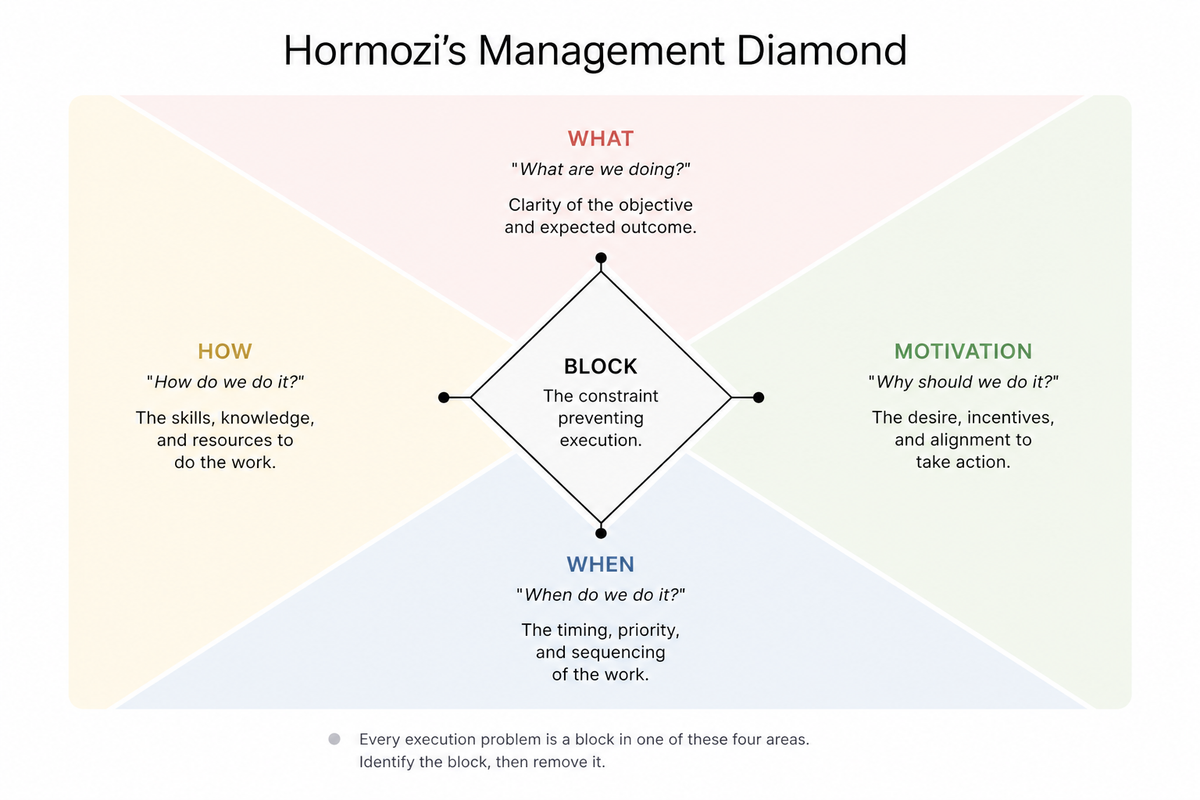
If anything, my engagements have grown; the agents just do a different shape of work, and I’ve had to learn how to delegate to them well. A few weeks ago I rewatched a clip from Alex Hormozi where he lays out what he calls the Management Diamond. Four reasons an employee fails to do what you wanted: they didn’t know WHAT to do, they didn’t know HOW, they didn’t know WHEN, or they didn’t know WHY it mattered. Watching it with a year of agent-delegation behind me, I noticed all four corners still hold up, though the shape of each one changes. The fourth changes more than the others.
WHAT
With humans, the WHAT corner is a communication problem. You weren’t clear, they didn’t catch what you meant, you have to say it again. With AI it becomes a data problem. On a recent engagement I sat down to figure out what to build into a client’s internal AI skill library. We could have brainstormed; the leadership team had a list of features they thought users wanted. Instead I pulled about 900 first-messages from their top users over the previous few weeks and classified what people were actually asking for. The wishlist didn’t match the data. The actual pattern, repeated dozens of times across users, was building presentations and structuring research. We built skills around those. The shift isn’t “use data instead of intuition”; any decent manager already does that. It’s that the unit of work AI handles is granular and frequent enough to study the way you can’t study a junior analyst’s daily decisions. AI generates legible work artifacts at a rate that human teams never have.
HOW
This is the corner that surprised me most. Hormozi’s three Ds (Document, Demonstrate, Duplicate) survive, but they invert. With a junior teammate, the document supports the demonstration: you write the SOP so they have something to refer back to after you’ve shown them how. With AI, the document is the demonstration. On a different engagement I built a follow-up workflow for a client’s account managers. After every client call, an agent reads the transcript, pulls out the action items, drafts a follow-up email in that AM’s voice, and flags commitments that look risky. The account manager opens the draft, edits, sends. There is no wiki page anywhere titled “how we follow up after client calls.” The agent’s prompt is that wiki page. New hires use the workflow on day one and pick up the firm’s style by reading what the agent drafts on their behalf. If the prompt works, the firm’s “how to do this thing well” is now copyable across the team. If it doesn’t, the prompt gets revised, not the people.
WHEN
Hormozi’s WHEN is about deadlines and human coordination. With AI it’s about constraint design. On a training program for the same client, the original session asked participants to spend 20 minutes on a hands-on exercise. Feedback after the first round was to cut it to 5-7 minutes. Twenty minutes was fine for the exercise itself; the problem was attention. Consultants billing in 15-minute increments don’t sit through long uninterrupted exercises on a Zoom call. The same logic shows up everywhere in agent work. Context windows, user attention spans, and the volume of questions you’re asking the model are all finite resources; designing the WHEN means designing how those resources get spent before the work degrades.
WHY
This is the corner that bends hardest. Hormozi’s WHY is motivation: tie the task to the mission so the person wants to do it well. AI doesn’t have a mission to attach work to. The corner stays in place, but its content changes. For an agent, WHY is success criteria. What “done” looks like, what to optimize for, what tradeoffs to make when the situation gets ambiguous. I sat through a discovery-phase retrospective recently where the team had built exactly the deliverable that was asked for. The work was technically sound but strategically empty; no one had articulated upfront what good looked like. With a person you can fix that mid-stream by reframing the mission. With an agent, if the success criteria weren’t in the brief, they don’t exist. The work runs to completion against the wrong target.
The Diamond didn’t break when I started delegating to agents. The skills that map to it have shifted, though, toward system design and brief-writing rather than coaching and reading a room. That’s the part to brace for if you’ve spent your career managing people and the agents on your team are starting to outnumber them.


