Dunning-Kruger Effect of Vibe Coding
I'm seeing a pattern that plays out when someone discovers they can use AI to build software. It follows the Dunning-Kruger curve almost perfectly.
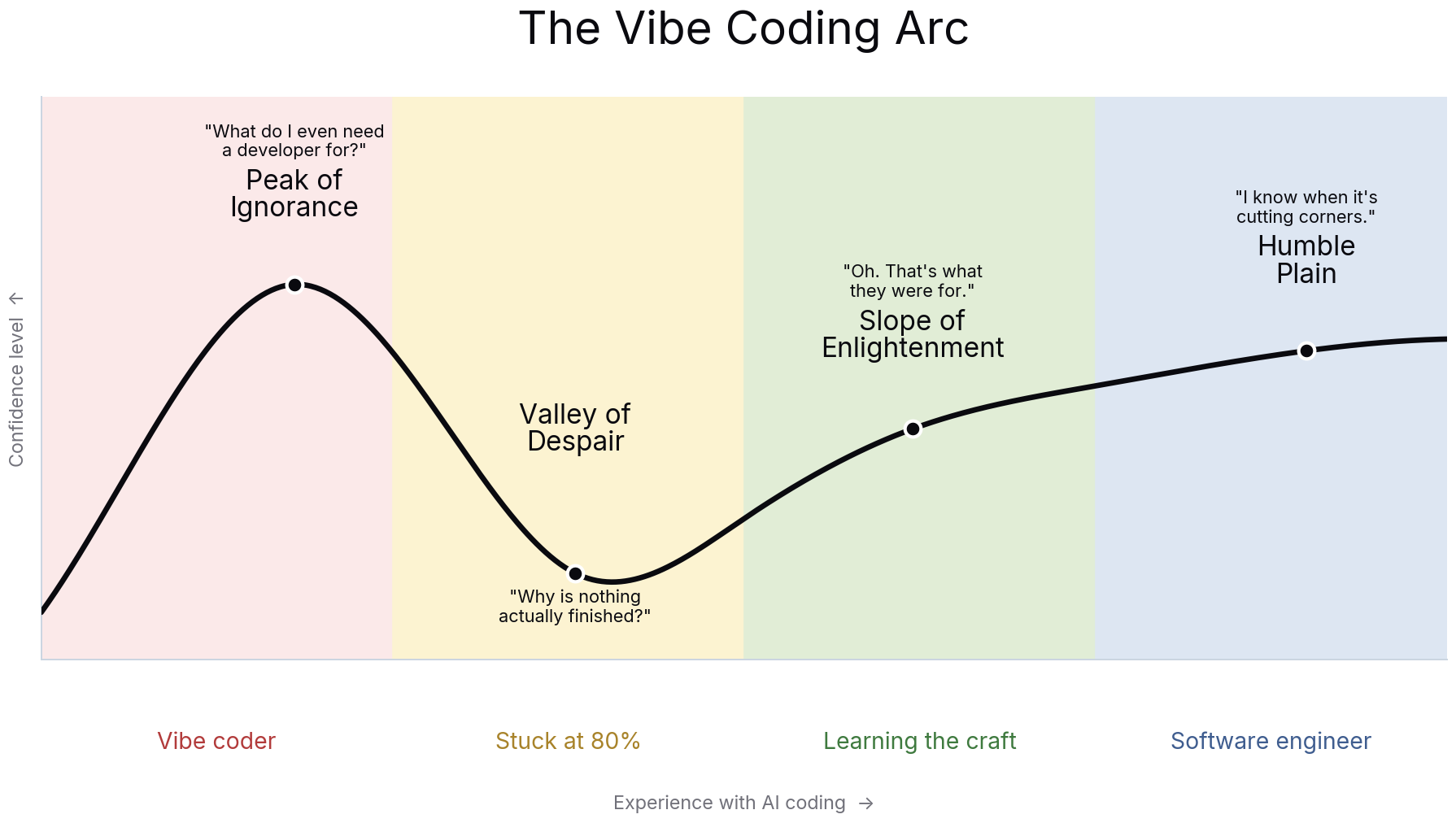
I'm seeing a pattern that plays out when someone discovers they can use AI to build software/apps. It follows the Dunning-Kruger curve almost perfectly.
It usually starts with a real need. A team or person wants a web application or an internal tool to fill a certain need. The requirements seem straightforward. The budget for a full development team isn't there. And then someone discovers that AI can build what looks like a full application in a few prompts.
You kick off with a prompt, maybe use Claude to enhance it. You describe what you want in plain language, and within minutes you're looking at a working prototype. Buttons, forms, logic, all wired up. NICE, it added our branding too? Awesome. You go from idea to demo in an afternoon, and the natural conclusion is: Oh wow, if I can move this fast, what do I need a developer for?
This is the peak... The moment where confidence outpaces competence. The output looks finished. It runs. You can click through it. Then you're showing your coworker the app you built and they ask for the link, and you send them to localhost:3000 or a lovable/replit link. Lol.
Then the questions start. Where does this get hosted? Can this handle 500 users hitting it at the same time? Who gets access and how do we manage permissions? You ask the AI to change one feature, and it rewrites three others. You fix a bug and introduce two more. There's no test coverage, no error handling, no logging (unless you really spent time on the PRD). The app works on your machine, in your browser, with your data. That's about it.
IMO, this is where speed turns into liability. Vibe coding gets you to 80% fast. But that last 20% is where engineering actually lives: security, scalability, maintainability, deployment, monitoring. Sure, you can tell the AI to account for all of that. But that assumes you know to ask for it in the first place. The average person building their first app doesn't know what they don't know, and the AI isn't going to flag what you forgot to mention.
I went through this arc myself. As someone who writes code professionally, my first reaction was panic. If anyone can prompt their way to an app, what's the value of knowing how to build one? The more I used it, the more I realized I was only effective with it because I already knew what to look for. I knew when the AI cut corners because I'd made those same mistakes years ago.
That's why, even with AI in the toolkit, we still need a software developer involved. AI removes the typing bottleneck and not the thinking one.
That means skilled developers suddenly move very fast because they know what to verify, while less experienced ones also move fast but don’t notice when things are subtly wrong. So the gap actually widens.
There are people using AI to ship real production code. The difference is they treat the output as untrusted, work in small steps, enforce tests, and review diffs carefully.
On autonomous agents: fully hands-off is mostly marketing. What works in serious contexts is bounded autonomy. The agent drafts, humans review, tests and CI gate changes. Without that, you get churn and architecture drift.
So it’s not “everyone can code now.” It’s that coding shifted from writing syntax to exercising judgment, and judgment is still the hard part.